
The Deal Gets Faster. The Risk Does Not Disappear.
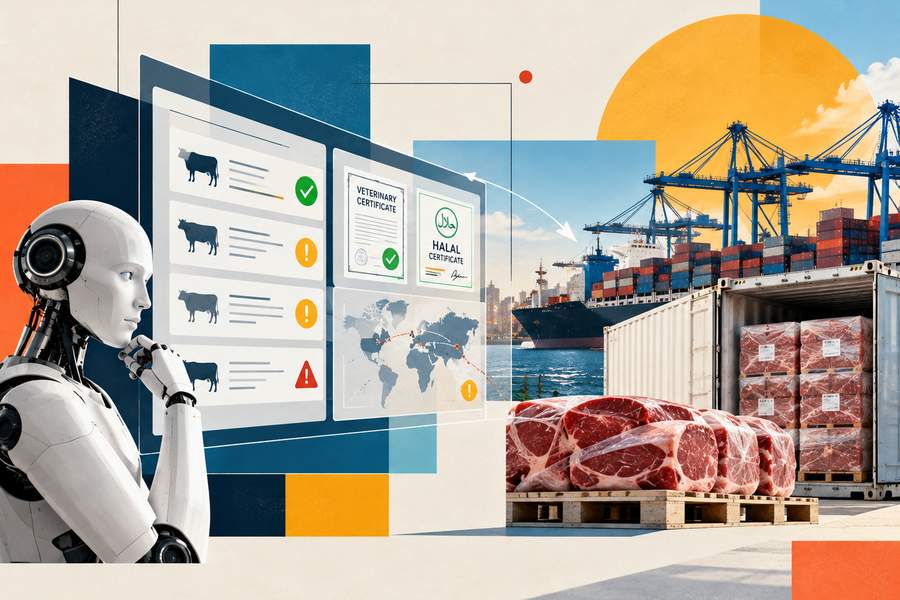
AI-assisted procurement is already compressing the slowest part of any cross-border trade: the search, comparison and document-checking that used to consume days before a transaction was even ready for a decision. Using one live scenario — an importer sourcing frozen beef from an overseas supplier — this piece traces exactly where machine assistance helps, where a system can flag risk but not accept it, and why the final approval of payment and contractual terms still has to carry a named executive's name, not a model's output.
Consider one transaction: an importer is sourcing frozen beef from an overseas supplier.
The specification is precise. Product grade, cut, packing format, production dates, veterinary documentation, halal requirements, temperature conditions and delivery terms all have to match. Price matters, but a cheaper offer is irrelevant if the shipment cannot clear inspection, the certificates do not stand up to verification, or the supplier cannot perform against the agreed terms.
Without AI: Where the Time Goes
Without AI, much of the work begins with people looking for information.
The procurement team identifies possible suppliers through existing contacts, databases and referrals. Quotations arrive in different formats. Someone compares specifications line by line. Company histories and available risk information are checked separately. Certificates are collected and their details compared with the requirements of the transaction. Commercial teams exchange revised offers. Legal or procurement staff compare the proposed contract against previous agreements and approved clauses.
None of these tasks is conceptually difficult. Together, they consume time because information arrives fragmented.
This is where machine-assisted tools are starting to change the shape of the work.
Where Machine Assistance Changes the Work
AI-assisted procurement platforms — increasingly used across trade-heavy sectors, according to recent industry reporting on B2B sourcing technology — can help structure sourcing requirements, narrow a supplier field against defined criteria and consolidate supplier intelligence into a single comparable view. Contract-analysis tools can extract clauses, compare language and flag deviations against a standard template. The machine is not deciding whether frozen beef should be purchased. It is reducing the amount of searching, reading and comparison required before somebody makes that decision.
Run the Same Transaction Again
The importer enters the required product specification. Instead of manually working through a long supplier universe, software helps narrow the field against defined criteria. Quotations are converted into comparable fields. Differences in packing, specifications, Incoterms or payment proposals can be surfaced rather than discovered during another round of emails.
Then come the documents.
Not Everything Digital Is AI
Here an important distinction matters: not everything digital is AI.
Electronic veterinary certification, government traceability databases and cold-chain sensor systems are, on their own, digital infrastructure — not intelligence. What AI adds is the layer on top: extracting information from these documents and data streams, comparing fields across sources, finding inconsistencies and directing attention to exceptions rather than requiring a person to check everything by hand.
For a meat importer, that difference is practical. A system may detect that a certificate number, production establishment, shipment detail or contractual requirement does not match another document. It can flag the discrepancy immediately.
But a flag is not an approval.
The same applies to the contract. Software can compare the supplier’s draft against the buyer’s standard terms and identify changes in inspection rights, claims periods, governing law, delivery obligations or payment conditions. What previously required people to find every difference manually can increasingly begin with an exception report.
The transaction has become faster because the machine has compressed the work of finding differences.
Then it reaches a line it should not cross.
Supplier discovery
Search, structure and compare a wider supplier field against defined requirements.
Document checking
Extract fields, compare documents and flag inconsistencies for review.
Contract comparison
Identify deviations in clauses, payment conditions and commercial obligations.
The handoff
When final payment and contractual terms create binding exposure, the task shifts from analysing risk to accepting it — that decision belongs to an authorised human.
Finding Risk Is Not Accepting Risk
Suppose the supplier meets the product specification and the documentation checks produce no unresolved exception. The commercial offer is attractive. But the supplier requests payment terms that expose the importer before performance has been fully demonstrated.
The system can describe that exposure. It can retrieve the supplier’s history, compare the proposed terms with policy and flag the departure from previous transactions.
It still cannot accept the exposure.
That is the handoff point: approval of the final payment and contractual terms that create the importer’s binding commercial exposure. A named executive must decide whether the company will put its money and legal position behind this counterparty on these terms.
Why here? Because the question has changed.
Until this point, the transaction is largely asking: what does the evidence say? AI is increasingly capable of helping answer that question.
At final approval, the question becomes: are we prepared to carry the consequences if this supplier does not perform?
The consequences arrive after the decision: delayed shipment, rejected goods, a certification dispute, a temperature excursion, a claim that cannot be recovered, or money committed to a counterparty that fails to deliver as expected. Software can estimate, detect and warn. It cannot become the party that accepted the commercial exposure.
This is the operational boundary that matters.
In the old transaction, people spent much of their time finding information before making a decision. In the AI-assisted transaction, machines can do more of the finding, sorting, comparing and flagging.
That should make the deal faster. It should not make the signature automatic.
- AI-assisted sourcing and document-analysis tools compress the search, comparison and exception-finding that used to take days — narrowing suppliers, converting quotations into comparable fields, and flagging certificate or contract inconsistencies automatically.
- A flag is not an approval: the system can describe a supplier’s payment-term exposure and compare it against policy and precedent, but it cannot decide whether the company is willing to carry that exposure.
- The handoff point is final approval of payment and contractual terms that create binding commercial exposure — that decision, and the name behind it, has to stay with an authorised human executive.

Rami Ahmed Hassan
Senior IT Specialist · Business Consultant · Writer & Editorial Contributor, Qasr Al Anqaa
He writes for CARAVAN on how technology and AI are changing deal-making, risk and trade policy.
Importing meat? QAA supplies it from its own supplier network and manages the whole supply chain for you: see meat sourcing. For any other product, QAA Trade Services buys it from your own supplier, or from one we find for you, then ships and delivers it.